Japanese Pop Idols: Sexuality as Subversion (my Mass Media and Pop Culture paper)

Hey guys!
So if you read my blog, you know I’m busy. Way too busy. And one thing I’ve been busy with is school. For the class I took this past semester, “Mass Media and Popular Culture,” we had to write a reflection paper based off of course readings. And as such, I chose to write about JPop idols. And so, I thought I’d share the paper with the internet/wotasphere.

Couple of things you need to know:
1. It’s in response to an article, “Women, Pop Music and Pornography” by Meredith Levande. It connects the female pop music industry to pornography, and essentially says that all female pop stars are sexually objectified and as such it’s an inherently bad thing. She also links these to pornography. I can’t show you the article, as I read it for class, but it focuses a lot more on Western pop music. So my paper was written from the “let’s show a different side” perspective.

2. Obviously the idol industry in Japan is really fascinating when thinking about it in terms of gender, and so nothing is cut and dry. I do think there are a LOT of really problematic issues with gender in the idol industry. However, since this was meant to be a short response paper, I sought to show a different side of the issue. The article by Levande is SO extreme that I wanted this to be almost a counter-balance to that.

And so, here’s my paper! If you have any questions, feel free to ask me. If you disagree with any of my main points, keep what I wrote above in mind, but I welcome it.

———————————————–

While American music is popular throughout the rest of the world, Japan also has a booming pop music scene. Most notably, girl groups have become extremely popular in the recent years, with popular group AKB48 leading the stride. Even though there is still some subordination involved with female acts in Japan, some of the most popular groups perform in ways to subvert the traditional Japanese image of femininity and female subjugation as a whole, in contrast to Meredith Levande’s theories of women in pop music.

In her article “Women, Pop Music, and Pornography,” Meredith Levande (2008) writes many bold statements in regards to women in pop music and how that in turn is using pornographic imagery. One of the most notable theories raised in this article is the idea that women in pop music are “under pressure to conform to the porn standard” (p. 307). According to Levande, women are ultimately forced to be hypersexualized and demeaned to sell well, which leads to the business of popular female artists being a business of sexism and women being portrayed in a sexist light. Furthermore, Levande is somewhat extreme in never bringing up any examples of sexuality actually being empowering, instead seeing any example of someone saying that they’re using sexuality as empowerment as compliance into the systematic sexism of popular culture.

Female artists have often been popular in Japan, but recently the popularity of female pop idols has been on the rise. While to a Western audience there might seem to be no difference between the terms ‘pop star’ and ‘pop idol,’ there is a sizable difference. Pop idols are young, usually female celebrities, working usually in their teens and early twenties, appearing in mass media. Though idols can be actresses, TV personalities or models, recently the pop idol has had a resurgence of popularity. Here, traditional male dominance does not occur in Levande’s description of sexuality or in the concept of the male gaze, but in a purer image, in which any sexuality lies hidden. As Brian Ashcraft (2010) describes in his book Japanese Schoolgirl Confidential, with many early idols “The thrill for male fans was in the power of suggestion and her coquettish schoolgirl image.” (p. 37). Sexuality existed, but hidden under a veneer of purity that corresponds with one of Levande’s point, that “There is an unnerving preoccupation with extremely young female pop stars who are simultaneously “innocent” and “slutty.’”(p. 308), though it was much more subtle here. Female idols in Japan have largely kept with this concept of the innocent idol, appealing to the male audience with this image. However, recent groups like the current idol powerhouse AKB48 and its sister group SDN48 have made waves in breaking from this, at least somewhat, allowing for more empowerment for Japanese pop idols.

AKB48 is undoubtedly the most popular idol group in Japan right now and the most popular one in years. In 2010, their singles “Beginner” and “Heavy Rotation” were the number one and number two best selling singles in Japan for the year, and their most recent single “Kaze wa Fuiteiru” sold over one million physical copies in one day (ORICON). As such, it would be expected that they follow the image that has made idols popular in the past. Traditionally, for example, idols haven’t been allowed to do adult activities such as smoking and even dating, in order to maintain this pure image. This is a practice that still continued with most girl groups today, though with more of a “don’t ask don’t tell” system, keeping any and all dating discrete in favor of keeping up that pure image. This is a practice that has been continued with AKB48 as well, though it is more lenient than groups of the past. However, despite this pressure to maintain the status quo of female innocence and subordination that has sold idol groups to fans in the past, many aspects of the group subvert these traditional ideals.

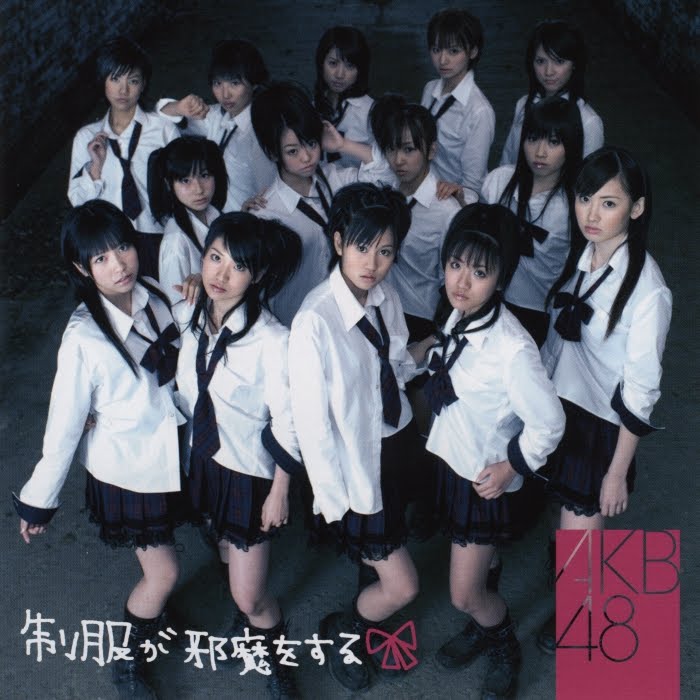
One important way that AKB48 subverts the ideals of innocence is the concept of the schoolgirl and the school uniform. As Katsuhiko Sano of the Tombow Uniform Museum explains, in the 1960s “uniforms came to represent the oppression of freedom” (Ashcraft, 2010, p.18). This isn’t the only case, and traditional school uniforms have come in and out of style depending on the time, but as Sano also mentions “Uniforms will always make the schoolgirl aware of what she is” (Ashcraft, 2010, p.24), thus emphasizing their cultural significance to the teenage schoolgirl, and to society. As mentioned earlier, the idol has a notable schoolgirl image, and AKB48 takes that further with wearing school uniforms as part of their costume. However, while wearing this image that can be seen as oppressive and conformity, the uniforms are rarely conforming. They wear instead interesting patterns, glitz, and glamour, taking this uniform and making it almost unrecognizable as being based off a uniform. AKB48 member Nito Moeno even said in an interview “The uniform I wear to school isn’t very flashy and somewhat dull, but he uniforms we get to wear on stage are very colorful. I feel much happier when I’m wearing one of them.” (Ashcraft, 2010, 48)

In AKB48’s music video to their single “Seifuku ga Jama wo Suru,” the group subverts the traditional ideal of Japanese femininity while simultaneously criticizing the male gaze and the objectification of women. First, most notably, the song and video are charged with sexuality and is theorized to be directly related to the concept of Enjo Kosai, which is a somewhat controversial subject to seriously relate to pop stars. Enjo Kosai is a term for women dating a man for money, a practice that doesn’t necessarily involve sex but can, and is such somewhat taboo. Having a girl group refer to this kind of a taboo issue is rare, something that continues in AKB48’s later single “Keibetsu Shiteita Aijou,” which is about teen suicide. The title of “Seifuku ga Jama wo Suru” is even referring to sexuality, literally meaning “My School Uniform is Getting in the Way” So while sexuality with idols is masked under a veil of innocence, here it’s fully on display, even referring to the mask these idols wore before.

Most notable in this is the full video. Throughout the video is a loosely linked story of Enjo Kosai, with dancing and close up shots of the idols on an entirely separate set. In the story sections of the music video, there are many uncomfortable scenes featuring what seems to be complete objectification of the idols without their knowledge or consent; shots of legs, of a backside, of lips, all without showing the face. In fact, throughout this part of the music video, any time there’s a face it’s pointed away from the camera, head usually down and eyes averted, as a clear sign of submission. However, after the shots of clear objectification there are clear medium shots of the idols staring at the camera. They aren’t singing with the song, or showing suggestive body parts, just looking at the camera. This is almost the opposite of objectification, and it forces the audience to acknowledge the humanity of the girl that had been previously objectified. The music video forces the audience to acknowledge their objectification. As Levande (2008) says, “the male pop star is physically absent from the video, but the male gaze isn’t. He is still ultimately the subject,” (p. 306), though here the male gaze and voyeurism presented is clearly shown as being negative.

Another girl group SDN48 uses sexuality and adult themes to directly subvert the idea of a traditional Japanese pop idol and thus uses sexuality as a form of female empowerment, a direct contrast to Levande’s statements. As mentioned before, the ideal Japanese pop star image is one of purity, or at the very least a surface of purity. Though notable artists in Japan have had sexuality as a major part of their act, such as the pop singer Koda Kumi, this hasn’t extended as far to the idol. However, SDN48 subverts a lot of this. First, the members of the group must be over the age of 20, thus past the age of schoolgirls. They are free from rules that govern other idols, such as dating (one member is married), and are free to talk about their dating (and thus sex) life at concerts and live events freely and without shame. Their music videos are even much sexier, with some almost nudity in “Ai, Chuseyo,” as well as posing nearly nude (covering themselves) in magazines. Levande (2008) asserts that “This is what I call compliance masked in defiance: taking your clothes off to be heard” (p.305); however, in this culture, it’s easier to be heard with clothes on, so these women chose to pose nearly nude for a reason, and simply the fact that such an idol group exists only goes to show how far these groups have come. They can now be fully adults and peers to their adult audiences, with less of the submission that comes with being a teenage pop idol.

Therefore, in a context separate from American culture, sexuality can sometimes be a tool for feminism and empowerment. Representations of male dominance and female submission are found in different ways, but different cultures can find different ways to subvert and thus eventually overcome the female suppression.

AKB48 and Google+: Quick Thoughts

Hello hello!

As many of you idol fans have seen, AKB48 is doing a collaborative effort with Google+, Google’s answer to social media such as Facebook and Twitter. While I do use Google+ (less than Facebook and Twitter, which are used for family/friends and my Once Upon a Time fandom, respectively), I haven’t been a very active user on it, other than with other Intl Wota contributors, but that might change due to AKB.

Some thoughts!

1. Watching the live stream of the events, the one thing that stood out most to me was that they emphasized international fans. Now this is mostly just me being an English-language speaking American fan of idols, but the fact that they’re acknowledging international fans in a way that isn’t “Oh, we have fans from America, isn’t that amazing??” is pretty new. Even though this new Google + announcement isn’t doing too much in bringing idol stuff to the US (I’d still like AKB/SKE/NMB songs on iTunes…), it’s still something that they’re trying to acknowledge fans. I haven’t figured out how they’re working the “AKB48 translator” (if anyone knows tell me!) but it’s pretty cool either way.

2. The hangout system is cool in theory, but as I saw when it launched it’s going to be VERY difficult to actually “hang out” with your idols. Maeda Atsuko’s was full almost immediately, which isn’t hard to imagine when full is only 10 people. If you’re in Japan it would probably be easier to go to a handshake event or something to get face time with your favorite idol than sitting on Google + hoping for a hangout. As someone who’s not in Japan, I guess I just have to hope that one of my favorites will do a hangout that I can be in.

3. the fact that underage members can’t participate. I mean, there’s nothing that can really be done, since it’s a part of Google+’s policy. Yet it’s kind of amazing how many members are in fact over 18. It’s disappointing for me personally, since my two favorite members (Oota Aika and Iwasa Misaki) are under 18, but I’ll just have to be fine with my favorite NMB48 girl, Watanabe Miyuki!

All in all, I think it’s a good move. It’s good promotion at minimum cost with Google and AKB48 both getting a lot out of the partnership. I doubt it’ll be anything revolutionary, but it doesn’t have to be. It’s the feeling of idols being even closer to you with little additional effort!

I Give Thanks to Idols! Happy Thanksgiving!

Hey guys!

First off, I have to apologize for being so bad with posting as of late. I’ve been just swamped with school work, and I’m really trying hard to be the best student I can this semester, in addition to my job (and for a brief while I had two jobs, gah).

Anyways, today in the US is the holiday of Thanksgiving! Now, I love idol holiday songs and thinking back on fandoms. However, there are some idol songs that stand out as somewhat fitting the day.

Mama Grazie! – Watarirouka Hashiritai 7

Now, the lyrics to this song entitled “Mama, thanks!” (originally supposed to be released around Mother’s day as a single before the earthquake) aren’t exactly the most thanksgiving related; it’s about a girl thanking a mom for helping her go on a date and break curfew even though she has a strict father. However, the upbeat song with the sentiment of thanks fits the day.

Thanks- GAM

What list about giving thanks would be complete without a song called Thanks?

Egao ni Namida ~Thank you Dear my Friends~ – Matsuura Aya

Ayaya sings “thank you” a lot; I almost put her single “Hyacinth” up on this list. But this is a heartfelt thank you song, so it’s something that really does fit the actual theme of the day.

However, I’m sure many of you that celebrated just care about food. And in that case….

Kurakura Dinner Time – v-u-den

You know I love my v-u-den, and a song about a dinner involving “stuffing cheeks” fully fits how many people approach Thanksgiving.

Some of you might be more excited about Black Friday, the day after Thanksgiving that’s popular for shopping. Well you can go to…

109 – AKB48


109, a famous store that AKB48 sang about!

Anyways, after that stretch of a list, here’s another list, my list of things about idols that I’m thankful for!

1. Idol music is basically the background music of my life; when I’m walking around I’m probably listening to idol music.

2. I’m so thankful for idol music for brightening my spirits. Even when life is tough, idol music has been there to make me forget for a little while.

3. I’m so so thankful for idols, since I can write about them for homework.

4. I’m thankful for idols being the inspiration for Happy Disco; I love writing my blog and I have so much fun doing so.

finally~

5. I’m SO thankful for idols because through idols I’ve been able to meet new friends. I’m so happy to know the staff of Intl Wota, Dani, Shioka and members on various sites. Even with ups and downs, the idol fanbase is a great one that I’m happy to be a part of.

Thank you, also, to anyone who reads my blog! Every single one of you goes appreciated!

Best Surprise EVER.

Now here’s something I never thought I’d see nowadays:


Here….


That’s right, it’s Ex-Morning Musume member Goto Maki visiting Dream Morning Musume! Not only that, she visited them on stage!

Now, while Gocchin isn’t my favorite OG (I like her, but prefer others), just seeing her on the stage with the rest of DMM makes me really excited. After leaving Hello!Project/UFA and joining Avex, it seemed like she was almost blacklisted. She never came back, and was rarely (if ever) mentioned by other  members. She wasn’t as taboo as Kago Ai, but she wasn’t very easy to hear from.

Then, I wonder, perhaps this is because she’s splitting from Avex? She hasn’t gone on hiatus yet, but her intent is clear.

So now, there is the inevitable question “Will Goto Maki join Dream Morning Musume?” which I have to answer with a tentative “probably not.” Gomaki joining DMM would be a dream come true for a lot of fans. Yet her Avex career was doing pretty well. She isn’t retiring out of lack of interest or poor sales; I genuinely believe her when she says she’s taking a break for herself. DMM would probably be fun for her, I imagine, but it would be a lot of work when she really could continue her solo career with Avex and do just fine with that.

Still, the fact that Goto Maki is able to stand on the same stage as DMM with Tsunku/UFA’s approval shows that there is still more opportunity for H!P fans to see more of Goto Maki, which I think has to be considered a good thing.

Clearly Tsunku Doesn’t Read Happy Disco

Hey guys who read Happy Disco; sorry for the LOOONG time where I didn’t write. I currently have one blog post that’s taking me forever and a day to write (my contest winner post, which is a really great topic but just a bit time consuming), but I’ve neglected Happy Disco. I am sorry. I’m currently balancing being a full time Film/Media Studies student while working two part time jobs (30 hours of work total). By the end of my day I kind of just want to play tetris and not write a blog about what I write in class. But I still love idols/Happy Disco.

Anyways, a while ago I wrote a blog entry for Intl Wota for the Summer Refreshment Program, writing about idols and summer. In case you haven’t seen it, HERE it is. One of the things I talked about was how AKB48 tends to go on a yearly schedule, with spring/graduation songs in the spring, happy summer songs in the summer, and other stuff year round. It’s a schedule that I think has worked for them, because they deliver something that’s expected while simultaneously giving new songs. It’s a good system.

Fall’s here and soon it will be winter. While there’s definitely a feel for winter in terms of tone and style, I never really think of any specific fall style. This tends to be when AKB in particular releases stuff that doesn’t really fit in the season, such as Beginner, RIVER, and the soon to be released Kaze wa Fuiteiru. For a long time, when considering seasons and idols, I always thought that fall was like the free space on a Bingo sheet, that it didn’t matter what you released as long as you released something.

Then I saw Amazuppai Haru ni Sakura Saku.

For those who aren’t aware, this is the upcoming collaboration single that Berryz Koubou and C-ute are doing together. This is a great idea for many fans.

But the concept of the song/PV are not great ideas.

Hear me out. I’m not talking about the song/PV. I think the song’s pretty boring, myself, and while the PV could be better I think that it’s pretty good considering that these are H!P PVs we’re talking about. No, I’m just going to talk about the concept.

The song/PV is focusing on a spring/graduation theme. In November. Now, admittedly, I don’t know the full translation to the song; my Japanese isn’t good enough to pick it up on just a couple of listens. For all I know there could be a line in there about how it’s about their boyfriend and how their blooming love is like the blooming sakura blossoms in Spring. Even if that was the case, the song is still about blooming cherry blossoms and the bittersweet spring. That’s what the title says, and even if the lyrics subvert it then the first listen or two will be thinking about spring. In fall.

Even if the song absolutely had nothing to do with spring, then the PV is all about graduations. They get a diploma. It’s a graduation PV, which happens in the spring.

Now throughout all of this I just have to wonder why. Why did UFA choose to do this? Was the song/PV too good of an idea to wait? It’s just a pretty standard thing. The song/PV aren’t special, and even if they realized “guys, I want to do a graduation song” why couldn’t they have done it in the spring, when those songs/PVs are actually marketable? In my other post I wrote:

” if AKB48 were to go “Christmas in July, we’re going to dance around dressed as Santa!” it would probably end up selling a good deal of copies to hardcore fans. However, that’s probably not going to grab the casual listener, unless the casual listener likes that kind of silliness. ”

I stand by that AKB could probably pull it off because it’s AKB. However, Berryz Koubou and C-ute aren’t AKB48, and their sales are in general dropping. The last thing they want to do is lose fans, and what they desperately want is to gain fans, but I don’t see how this song/PV could attract casual listeners to become Berryz or C-ute fans.

Like I said, my big question is why. If they wanted to capitalize on the seasons, why couldn’t they wait a bit longer, or do a holiday-themed song/PV in vein of Aitai Lonely Christmas. I’m honestly baffled at the decision making skills here, and like I said, clearly Tsunku (and UFA) doesn’t read Happy Disco. I just really can’t see why this was considered to be a good idea on a sales standpoint.

You might be going “ah, Serenyty, stop with the sales already, they don’t care about sales.” If that’s true, then why do a graduation song now? What artistic goal are they trying to achieve by this? I’m really wondering, what would make this happen?

So therefore, I just have no idea why Berryz and C-ute are doing this, and I know others are confused too. Confusing and potentially alienating an audience is the thing they have to think about, and they might just be close to doing that.

On a separate note I saw the Mobekimasu song/PV and it’s alright. The main things I got from it are that I absolutely love the dresses they’re wearing, and that Maimi is really really adorable.

The Morning Musume Risk Paradox

Earlier I saw a new post on Intl Wota about Morning Musume and popularity. Now, this question has been discussed over and over again. I remember this being asked back when I first found Morning Musume, back in early 2008, and I know this discussion of what Morning Musume is doing right/wrong has been going on for a while. However, something in Cat’s post HERE has made me think about this question a bit more, and apply a little something I’ve learned in my Mass Media and Popular Culture course at my university. This I will henceforth call the Morning Musume Risk Paradox.

One of the issues that Cat brings up why Morning Musume doesn’t get on TV shows anymore and why they’ve been in a downward spiral of promotions. While she astutely says that Morning Musume is less popular now than they used to be, this is I think only part of the issue. Yes, Morning Musume is less popular, but I do think a big part of that is because of their less frequent television appearances.

Why doesn’t Morning Musume appear on TV more? The answer lies in the concept of Risk. No, not the board game, but the idea if something is risky, or dangerous. Now you might be wondering “what’s risky about having Morning Musume on TV?” The reason that risk comes up in talking about television and media is because the one thing that companies (including media related) try to do above all else is to minimize risk, especially when it involves losing money. Television shows cost a lot to film and produce, and so it only stands to reason that a TV show is going to focus on what makes up that money and minimize risk in doing so. Same for things like film/drama opportunities.

However, this really just reminded me of a recent complaint I saw, and that was that groups with lesser sales and various KPop groups got TV shows, but not Morning Musume. However, this is still in effect minimizing risk. KPop is booming right now, so it makes sense they’d get on the various music programs. Now, in the case of the groups with lesser sales, let’s compare with a hypothetical. Suppose you had two music shows in front of you. One show had a new, up and coming artist that you may have heard of, but the group’s in a genre you enjoy and you’ve been thinking of giving them a shot. Conversely, there’s another show with a group that you used to like but haven’t followed for years, doesn’t have any of the same members you liked, and will perform their most famous song again. Now, I’m sure some of you are going “I’d choose the second one!” since you realized that’s Morning Musume (and the song is Love Machine). However, would a TV show rather be the show that discovered and helped a group to fame (basically what could be said for the MM/Utaban relationship) or the show that iddn’t know when to let a group die.

It’s tough, and I know it does suck, especially  if you want to see your favorite group succeed. However, television is a business, and the media industry is all about minimizing risk factors, and I doubt that we’ll see a huge surge in Morning Musume in television promotions unless for some reason they become really popular.

However, don’t think that Morning Musume is immune to the whole minimizing risk aspect. That’s why it’s a paradox. Have you noticed that sometimes H!P releases sound alike? They have all the same front girls for years? The PVs will consist of a dance shot with some close ups and some other miscellaneous shots? Morning Musume is minimizing its risk too, focusing a lot on trying to please the demographic that it has right now. The group is dropping in sales after every single release, and that’s got to be scary for management. At this point, H!P is pretty set in its ways, to try and make sure that sales don’t drop any lower, by appealing to Morning Musume wota.

This is also shown in things like concert setlists, the DVDs/shows H!P produces, and the PVs. There is hardly any change from H!P product to product, and most of the change is superficial (i.e. the new Morning Musume PVs have new graphics, but use them to make a pretty standard PV in terms of story/editing).

That’s where the paradox is. Television shows won’t put Morning Musume on the shows because they’re not popular enough, but Morning Musume needs these shows to be popular. Television shows are minimizing risk by not having Morning Musume on, but by minimizing risk it’s doubtful that Morning Musume will gain new fans. It’s a tough situation, and I don’t know if there’s anything that UFA/H!P could do to make this situation better, but Morning Musume is indeed stuck in a conundrum.

Thoughts on Aibon

I’m sure this is old news to anyone who reads this blog, but this morning of September 11th 2011, Kago Ai attempted to commit suicide.

When I saw the news online today, I can say that I was in shock. Granted, Kago Ai isn’t the idol I’d be most surprised to see doing something like this, but it’s still a hard thing to see. Ai has never been one of my favorite idols. Perhaps it’s because I became a H!P fan after her initial scandals, but she’s not one of the girls I like best. However, I do hold 4th generation Morning Musume in a special place, partially because of it being Rika’s generation, but also because I think they were monumental in MM history.

It’s really hard to see Kago hurting like this, and I’m honestly somewhat at a loss of words for this. It’s easy to blame her, to be upset at her or to find one aspect of her life that she should change. Anyone who writes this sort of thing isn’t necessarily wrong. Kago is obviously in a tough place in her lie and something has to give. However, suicide isn’t a light decision, and depression is a complicated disease to deal with.

The one thing I think about all of this is that above all Kago needs help. She needs to talk to someone and get things straightened out, which is beyond dumping her boyfriend or quitting her showbiz career.

The thing that I think she needs more than anything are people in her life who care about her enough to urge her to get help or to be there for her, which I don’t know if she has. She has a public enough life for us to know that her family life has been dysfunctional from the start.

I’m keeping Kago Ai in my thoughts and I really do hope that she can get the help that she needs. One thing I want the online idol community to get is that depression and suicide are serious things. If you feel depressed or like you want to commit suicide, please go find help or call a hotline. What you’re going through is rough, but please seek the help that you need.

National Suicide Prevention Lifeline:

 1-800-273-TALK


Scandals. Hoo boy.

First off, thank you so much to anyone who wished me well. I really do appreciate well wishes for this time.

Secondly, when I was thinking of what to do after my last post, I was thinking I’d do something happier. The thought was to finally finish my epic PV post or review the new Morning Musume PVs (which I will do, because I have a lot to say). I wanted to do something that would be a bit happier than my other post.

Then scandals happened.

In case you haven’t heard, there has been a recent wave of scandals hitting AKB48 and its associated groups. Some girls in AKB got suspended (or rather, say they suspended themselves, but really, let’s not believe that PR BS), but they weren’t girls I knew that well. Oba Mina’s scandal was pretty interesting, given the accusations of Enjo Kousai. I mean, that was the least proven of all her scandal things, from what I can tell, but if you didn’t think of Seifuku ga Jama wo Suru you are not an AKB48 wota.

Acchan and Takamina are judging you pretty hard right now, Minarun.

I thought the whole affair was a bit funny and brushed it off, though I did feel bad for other girls that were dragged into it, especially if any dating happened before they joined AKB48. Regardless of how you feel about dating rules/restrictions, it is part of what it takes to be an idol and breaking those rules is breaking contract.

When the first NMB48 scandals hit, I felt a bit odd. I mean, I didn’t follow Matsuda Shiori that much, but I really liked Yoshida Akari, so their suspension was a bit rough. I saw what they allegedly did (saying that because nothing is confirmed) and while I felt that what they did was a bad judgment call, it wasn’t the end of the world. It was really dumb, but since no photos or anything appeared I didn’t think it was necessarily too awful.

All in all, through these scandals I maintained a calm about them, and wasn’t do disturbed by them. I hadn’t been too upset by scandals in the past, why be upset now?

Then that all changed when Kondo Rina and Watanabe Miyuki were cut from NMB48’s second single. And I was furious. I wondered why for only a brief moment, but realized that this is the first time that any idols I’m particularly close to have dealt with a scandal like this.

If you’ve seen my latest top 10 idol list, you know that I adore Watanabe Miyuki. She’s everything I want from a front girl and more and I’m a huge fan of hers. What you didn’t see was the fact that Kondo Rina is actually my second favorite NMB48 girl, with her adorable smile and her non-reactions on NMB’s show Naniwa Nadeshiko.

I’ve heard of scandals in the past, and I’ve seen them. I’m amused, but it goes without saying that when they affect you, they really do sting.

I haven’t seen this so much with this scandal, but one thing that I’ve always thought about when it comes to idol scandals is the concept of supporting them. Would I keep supporting an idol after a big scandal if I liked them? If I had been a big Kago Ai fan and then realized that she was dating older men and smoking underage, would I still be her fan?

It’s an interesting question, one that I think that ultimately people have to decide for themselves. Idol fans who have idols in the midst of scandals really just have to decide if what the idol did was wrong and if that is a reason to stop following an idol or to support them less. Dealing with idol scandals is kind of a personal thing, and while it might sound sappy it’s what fans need to do. The decisions might be easy, might be hard, but they must be made.

While the general perception of wota is that they are enraged whenever an idol does anything bad and decides to stop following her, I think that in reality most wota are more moderate. I think that there’s a really large population of fans that WANT to support their idols more than anything. Take the Fujimoto Miki wota; after her scandal where she was undoubtedly dating her (now) husband, what did they do? They didn’t bash Miki, they bashed the tabloids, because they wanted Miki to be left alone.

Ultimately, I don’t think that wota are necessarily put off by scandals like dating. Some might, but it’s definitely not most. Some may like idols JUST for the idea of them being surrogate girlfriends, but I think that when you get to be into one idol, you ultimately like them so much that you just want them to be happy. I know this opinion is slightly controversial, especially since idols are seen by many to JUST be surrogate girlfriends, but I think that with genuine affection comes genuine well-wishes for a girl.

So my choice was pretty clear, to keep supporting Watanabe Miyuki (and Kondo Rina) throughout the future. I’m bummed that Milky got cut from the next NMB48 single, yes. I do think this will be a speedbump in her career and she has to be careful to bring herself from it. But when I saw her blog entry about this, I wrote a comment of support, and now there are over 3000 comments on her blog, with pretty much everything I saw being positive towards Milky. So I’m going to remain hopeful, and keep on cheering on my favorite NMB48 idol!

In Memoriam: Idols In Tough Times

First of all, an apology and an explanation. I moved to this new blog on Intlwota and I’ve lately been neglecting it, at least more than I did on my blogspot blog. It didn’t go unmissed, but it wasn’t really something I felt up to this past weekend. The reason being, and I don’t want Happy Disco to get into a sob fest or to get too unhappy, is because this morning my Grandpa passed away. This wasn’t a surprise, because he’s been struggling with Lewy Body Dementia for a while now, and this was inevitable given his disease.

To be honest, I didn’t think I would be blogging about this. I thought I’d take some time off, get happier and be able to move on. Initially, when thinking about this in the nursing home while sitting with my Grandpa, idols weren’t really on my mind. I actually thought about the character of Kate Beckett from the show Castle, who had to deal with the death of her Mother. I told myself to “be strong like Kate” and that did help me through.

However, one song and PV in particular jumped into my head at various intervals. I didn’t try to think of it, and it was tough to think of (I initially started to cry again when I thought of it) but it really fit my situation.

AKB48’s Sakura no Ki ni Narou. Now the lyrics seem to be a bit more ambiguous, but the PV’s definitely not. The PV features Jurina as the friend of the front girls who has died, but is still there with them. Some people might be all “Jurina’s a ghost!” (even though I haven’t seen that reaction) but I tend to think it’s more symbolic, to show how the people you love are always there with you, even if you’ve lost them. In the wide group shot, the presence of an empty chair is in my opinion one of the most poignant things I’ve seen in an idol PV. It really shows that when it comes to people you love, when they leave that absence really cannot be filled in your life.

It’s a beautiful PV that came to mind, and while I can’t say it made me feel better, necessarily, it made me feel a bit of comfort in that how I feel now has been felt before.

Last night, when I came back from the nursing home after sitting with my Grandpa, that’s when idols came to my aid and comfort. I was depressed, knowing that things weren’t going well with my Grandpa, but there was nothing I can do. The one thing that made me feel better was idol music, listening to things like Sekai Ichi Happy na Onna no Ko and Wagamama Collection and watching Oota Aika’s confession scene from AKB48 1/48 Idol to Koishitara.

I’ve seen people get not necessarily upset but criticize idol music and idols in general for being escapist, for idol fans to use idols as a way of escaping their drab lives. I’ve seen this most as people criticizing idols for being “fake girlfriends” or something like that. I’ve even seen this said by AKB48 fans, wishing that AKB would go back to edgier songs like Keibetsu Shiteita Aijou and Seifuku ga Jama wo Suru. And yes, I’d say that idols can be escapism. But you know what, I say “So what?” If giving me a few moments reprieve from grief, then I accept the escapism with open arms.

Idols are chiefly about happiness, at least that’s what I would say. That’s part of why I love idols and why I named this blog Happy Disco. Like Aoi Usa said in her post I covered for IW, idols can be friends when you need them. And when I needed some happiness yesterday, I was able to turn to idols.

So thank you, AKB48, C-ute, Momoiro Clover, Morning Musume, and all the other idols I hold dear. I appreciate it.


My Top Ten Idols Redux

A while ago I was looking at my old posts on the old Happy Disco, and I noticed how completely out of date my old top ten idols blog post was. It has been quite a while since I wrote it, but in that time my tastes have almost completely changed, most notably with my current love for the assorted AKB groups as well as Momoiro Clover. So I thought that with this new blog I have the perfect opportunity to make another list of my top ten idols and why.

Continue reading